
You watch your child brush every night, yet the dentist still finds a cavity. That is a frustrating place to be. Deep grooves on back molars trap food and bacteria that a toothbrush cannot reach, and that is where most childhood decay starts.
Dental sealants for children are thin coatings painted onto the chewing surfaces of back molars to block cavities. The Centers for Disease Control and Prevention reports that sealants prevent about 80 percent of cavities for the first two years and keep protecting against half of cavities for up to four years. The visit is quick and painless. For most families, prevention costs far less than a filling later.
At La Mesa Pediatric Dentistry, Dr. Sarah T. Silverstein, DMD, MPH, is a board-certified pediatric dentist who works only with children. That focus matters here, because sealants need careful placement on small, still-erupting molars to work well.
What this costs, in short
- Sealants run about $30 to $60 per tooth on average, and the ADA puts the typical cost near $66 per tooth.
- The CDC reports sealants prevent roughly 80 percent of back-tooth cavities for two years and half for up to four years.
- Most children get sealants on 4 to 8 back molars, applied in a single short visit with no drilling.
- California marketplace plans cover preventive sealants for kids, often in full, under Covered California rules.
- Ask your dentist to check sealants at each routine visit and repair small chips early.
Dental sealants for children, explained
Dental sealants are thin plastic coatings painted onto the chewing surfaces of back teeth, where deep grooves collect food and bacteria. The sealant flows into those grooves and hardens fast, forming a smooth shield. It blocks the pits and fissures that a toothbrush struggles to clean. This is one of the most common preventive treatments in pediatric dentistry.
Molars and premolars do the heavy chewing, and their surfaces are bumpy by design. Those bumps hide narrow grooves. Food and plaque settle in and sit there. The CDC notes that 9 in 10 cavities happen in these back teeth, which is exactly where sealants go to work.
Sealants do not replace brushing and flossing. Think of them as a second line of defense on the spots daily care misses most. Your child still needs to brush twice a day and floss once a day. A sealant simply guards the one place a young brusher tends to miss.
Do dental sealants hurt?
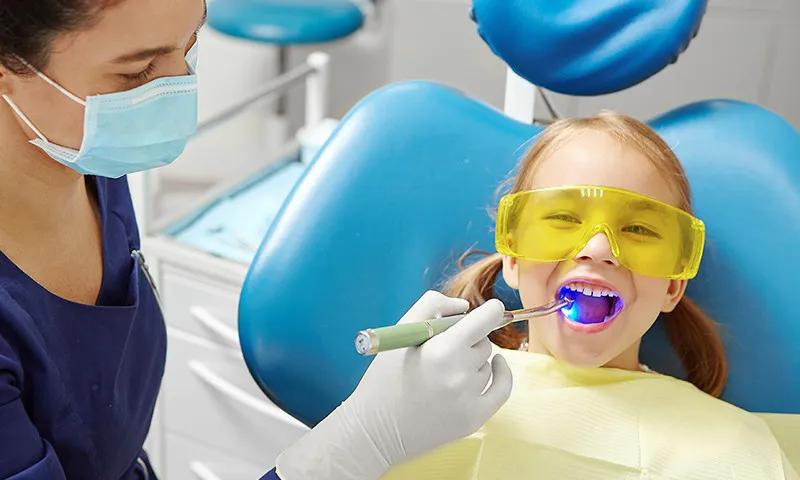
No. Applying a sealant does not hurt, and it needs no needles, no drilling, and no numbing. Your child sits in the chair while the dentist cleans and dries the tooth, brushes on the coating, and hardens it with a curing light. The whole thing takes only a few minutes per tooth. Kids can eat and drink right after.
That comfort matters for a nervous child. Many kids brace for the worst at the dentist, so a treatment with no shots and no sounds of a drill can change how they feel about the whole visit. A calm early experience makes the next checkup easier.
For a child who is already anxious, we can walk through each step first, showing the tools and letting them feel in control. Sealants are often a good first “real” procedure because they go so smoothly. The only sensation most kids notice is a mild taste from the cleaning gel and a cool light near the tooth.
How much do dental sealants cost?
Dental sealants for children usually cost $30 to $60 per tooth, though the American Dental Association puts the average closer to $66 per tooth. Price shifts with your location, your dentist, and how many teeth get sealed. Most kids receive sealants on 4 to 8 molars. Insurance often covers the cost as preventive care, which can lower or erase your share.
The real number worth knowing is the gap between prevention and repair. A sealant is a small, one-time cost per tooth. A filling costs far more, and a filling is not the end of it. A filled tooth may need repair, a crown, or root canal treatment over a lifetime, and each step adds cost.
Dentaly.org notes that a sealant runs about a third of the price of filling a cavity. Spending a little now on a healthy molar tends to cost you far less than treating that same molar after decay sets in.
Does insurance cover sealants in California?
Usually, yes. Children’s dental coverage is one of the ten essential health benefits under the Affordable Care Act, and every Covered California health plan includes it. Preventive care like exams, cleanings, and sealants is covered in full for kids, even before you meet a deductible. That makes sealants one of the easier preventive treatments to say yes to.
Covered California also caps what a family pays. Out-of-pocket dental costs for a child will not top $350 per child, or $700 for two or more children, under current plan rules. Private and employer plans differ, so the exact benefit depends on your policy.
Many private plans cover sealants for children up to age 14, sometimes 18 or 19, on permanent molars. A common rule is one sealant per tooth every five years. Plans usually apply to first and second permanent molars that have no decay or filling. Our front desk in La Mesa can review your benefits before treatment so you know your share ahead of time. We would rather check coverage first than surprise you at checkout.
How sealants save you money over time
Sealants save money by stopping cavities before they need fillings, crowns, or more. A study reported by the American Dental Association found that children with sealants get about three times fewer cavities over five years than children without them. Fewer cavities means fewer dental bills, less time off school, and less pain for your child.
The public health numbers back this up. A 2016 study in Health Affairs found that sealing 1,000 children’s teeth in school programs prevented 485 fillings. The CDC estimates each sealed tooth saves more than $11 in future treatment costs, and that sealing the roughly 7 million low-income kids who lack sealants could save up to $300 million.
Those are population figures, but the logic holds for one family. Prevent the cavity, skip the filling. A sealed molar that stays healthy through the school years is one you may never pay to repair. There is a comfort cost too. A sealant spares your child the drill, the numbing, and the missed school day that a filling can bring.
When should my child get sealants?
Sealants work best right after the permanent back molars come in. First molars usually erupt around age 6, and second molars around age 12. Sealing a molar soon after it appears protects it during the years when brushing habits are still shaky and cavity risk runs high. Dentists can seal baby molars too when a child is prone to decay.
Timing matters because a sealant only goes on a healthy, decay-free tooth. If a cavity has already started, the dentist treats that first, then may seal the tooth to guard against new decay. Catching molars early keeps the simple option on the table.
This is why steady checkups pay off during grade-school years. At La Mesa Pediatric Dentistry, Dr. Silverstein watches each molar as it erupts and recommends sealing at the right moment, not too early and not after decay has crept in. A molar that erupts only partway may need a short wait before it can hold a sealant well.
Are dental sealants safe for kids?
Yes. The CDC and the American Dental Association both consider dental sealants safe and effective, and dentists have used them for more than 40 years. The materials are FDA-cleared. Some parents ask about BPA exposure during placement. The amount is very low, far below any level of concern, and it is a one-time trace at application.
Sealants are among the least invasive treatments in dentistry. Nothing gets drilled and no healthy tooth structure is removed. The dentist simply cleans the surface and paints on a protective layer.
The main upkeep is simple monitoring. Sealants can chip or wear down over years of chewing, so the dentist checks them at routine visits and repairs any that thin out. Well-maintained sealants can last 5 to 10 years, and a worn one is quick to touch up. This is one more reason regular checkups earn their keep during the grade-school years.
Getting sealants for your child in La Mesa
If your child’s first molars have come in, or their second molars are on the way, it is a good time to ask about sealants. The visit is short, painless, and often fully covered for kids. Prevention now is far simpler than treating a cavity later.
At La Mesa Pediatric Dentistry, Dr. Sarah T. Silverstein, DMD, MPH, and our team care only for children, from first-tooth checkups through the teen years. We will check which molars are ready, review your insurance benefits, and answer any questions before we begin. To schedule a visit for your child, call our La Mesa office at 619-303-8342.